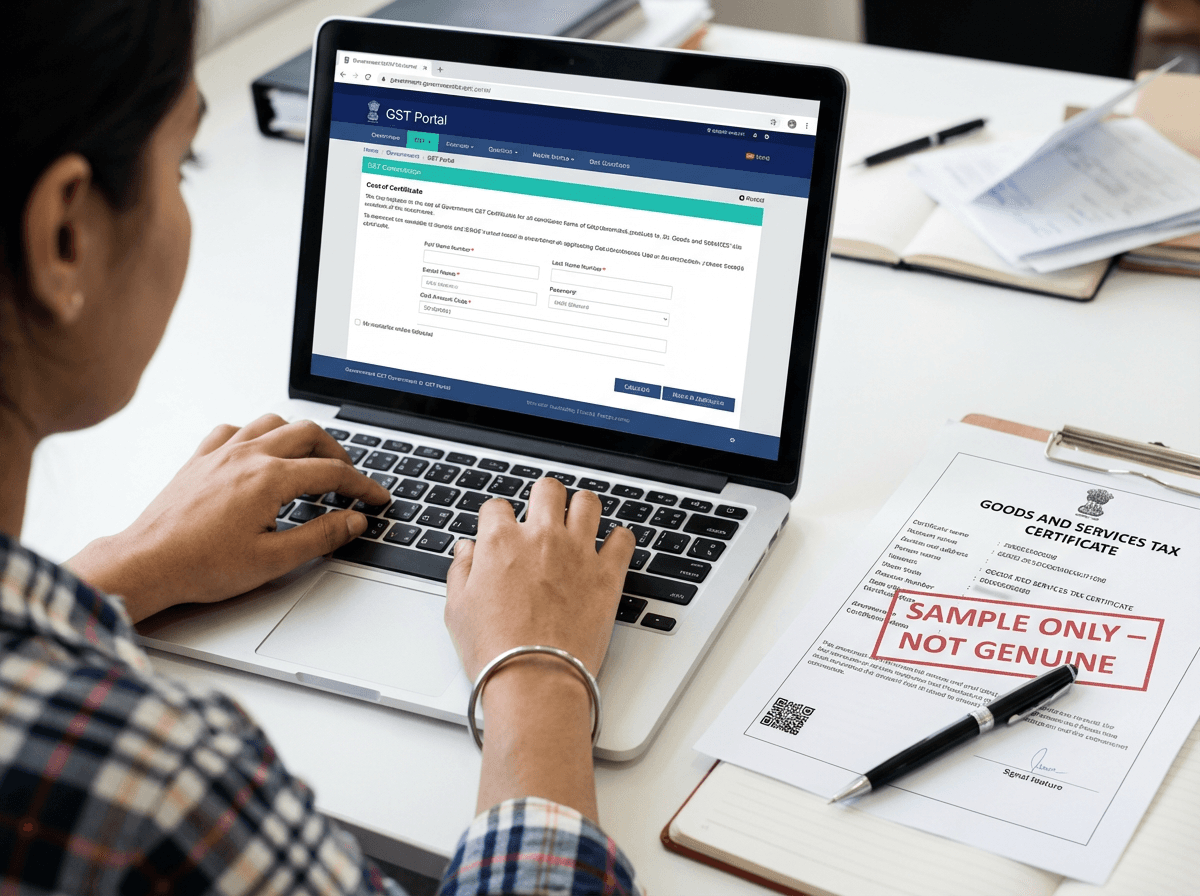
GST Registration & Compliance

What is GST
Goods and Services Tax (GST) is India’s indirect tax applicable on supply of goods and services. It merges all major indirect taxes and requires every eligible business to obtain a GSTIN for legal operation, invoicing, ITC claim, and compliance.
Who Should Apply for GST Registration
Below are the exact categories with turnover limits and mandatory cases:
1. Turnover-Based Mandatory Registration:
• Goods Suppliers: Annual turnover above ₹40 lakhs
• Service Providers: Annual turnover above ₹20 lakhs
• Special Category States: Threshold ₹10 lakhs
2. Mandatory Even if Turnover is Low:
• Inter-State supply of goods
• E-commerce sellers (Amazon, Flipkart, Meesho etc.)
• Businesses supplying via e-commerce operator (even if small)
• Reverse Charge Mechanism liability receivers
• Non-resident taxable persons
• Casual taxable persons
• TDS/TCS deductors under GST
• Businesses involved in export/import
• Agents or intermediaries supplying on behalf of others
3. Voluntary Registration (Recommended for):
• Start-ups wanting B2B clients
• Businesses needing Input Tax Credit
• Businesses participating in tenders
• Entities wanting structured billing
Types of GST Registration
• Regular GST Registration – For normal businesses with full ITC and monthly/quarterly filing
• Composition Scheme – For small businesses (turnover limit up to ₹1.5 Cr)
• Casual Taxable Person – For temporary shops, exhibitions
• Non-Resident Taxable Person (NRTP) – For foreign suppliers
• Input Service Distributor (ISD) – For distributing ITC within branches
• E-Commerce Operator Registration – For platforms collecting TCS
Benefits of GST Registration
• Legally supply goods/services across India
• Ability to collect and claim Input Tax Credit
• Eligible for government/PSU/private tenders
• Smooth B2B onboarding (vendors demand GSTIN)
• Reduces tax leakage and increases compliance rating
• Helps expand business across states
• ERP and billing software compatibility
• Avoids penalties, notices, and legal action
Documents Required for GST Registration
Individual / Proprietorship:
• PAN Card
• Aadhaar Card
• Photograph
• Bank statement / Cancelled cheque
• Address proof (electricity bill, NOC, rent agreement)
Partnership Firm:
• Partnership deed
• PAN + Aadhaar of partners
• Business address proof
• Firm bank details
• Authorisation letter
Company (Pvt Ltd / LLP):
• Certificate of incorporation
• MOA & AOA / LLP Agreement
• Board Resolution
• PAN of company
• Director IDs & Aadhaar
• Registered office proof
• Company bank proof
Step-by-Step GST Registration Process
1. Eligibility Check:
• Turnover check
• Business category check
• State-specific rules check
2. Document Preparation:
• Verify KYC documents
• Ensure address proof validity
• Prepare authorisation formats
3. Portal Application Filing:
• Create account on GST portal
• Submit form GST REG-01
• Upload documents
• Provide business details
4. Verification & Query Handling:
• Reply to officer queries
• Re-submit missing documents
• Track ARN status
5. GSTIN Approval & Certificate Issued:
• Download GST Certificate
• Activate online profile
• Setup invoice format
6. Post Registration Setup:
• HSN/SAC configuration
• Bank linking
• E-way bill login activation
• E-invoice (if applicable) setup
GST Compliance (Monthly, Quarterly, Annual)
1. Monthly/Quarterly Filing:
• GSTR-1 – Outward supplies (monthly or quarterly)
• GSTR-3B – Tax summary & payment
• CMP-08 – Composition taxpayers quarterly
2. Annual Compliance:
• GSTR-9 – Annual return
• GSTR-9C – Reconciliation (if turnover exceeds threshold)
3. Auto-Reconciliation:
• Match GSTR-2B with purchase records
• ITC claim validation
• Avoid mismatches that trigger notices
4. E-Invoice System (Mandatory for):
• Businesses with turnover above ₹5 Crores (last FY)
• Some notified sectors irrespective of turnover
5. E-Way Bill (Mandatory when):
• Movement of goods value above ₹50,000
• Inter-state movement (most cases)
• Specific notified situations—even without invoice amount
Penalties & Important Time Limits
• Late filing fee: ₹50 per day (CGST+SGST)
• Interest on tax: 18% per annum
• Penalty for no GST registration:
– 10% of tax due or ₹10,000 (whichever higher)
• Penalty for wrong ITC claim: Equal to ITC amount
• E-way bill penalty: ₹10,000 or tax amount (higher)
• Notice for mismatch if GSTR-1 ≠ GSTR-3B
Frequently Used GST Forms
• GST REG-01: New GST Registration
• GST REG-06: GST Certificate
• GSTR-1: Invoice details
• GSTR-3B: Tax payment
• GSTR-9: Annual return
• GST PMT-06: Tax challan
• GST ITC-01: ITC for new registrants
Why Businesses Prefer Our GST Services
• Zero-error registration
• Complete monthly compliance management
• Auto-reconciliation of invoices with GST portal
• 100% support for notices, audits, assessments
• ERP + E-invoice + E-way bill integration experts
• Dedicated account manager
• GST data review before every filing
• Transparent pricing & documentation
What You Receive from Us
• GST Certificate + active GSTIN
• Complete invoice format setup
• GSTR-1 + GSTR-3B filing every cycle
• E-way bill & e-invoice login setup
• Monthly reconciliation report
• Annual return filing
• Real-time support for notices & audits
FAQs
Q1. Is GST registration compulsory for small businesses?
If turnover crosses ₹40 lakhs (goods) or ₹20 lakhs (services) → Mandatory.
Certain categories must register even with ₹0 turnover (interstate suppliers, e-commerce sellers).
Q2. Can I register voluntarily?
Yes—ideal for B2B, tenders, and ITC benefits.
Q3. Can I operate in multiple states?
Yes, but GST registration required in each state where business is conducted.
Q4. Is Composition Scheme good?
Good for small traders but no ITC and no interstate supply allowed